
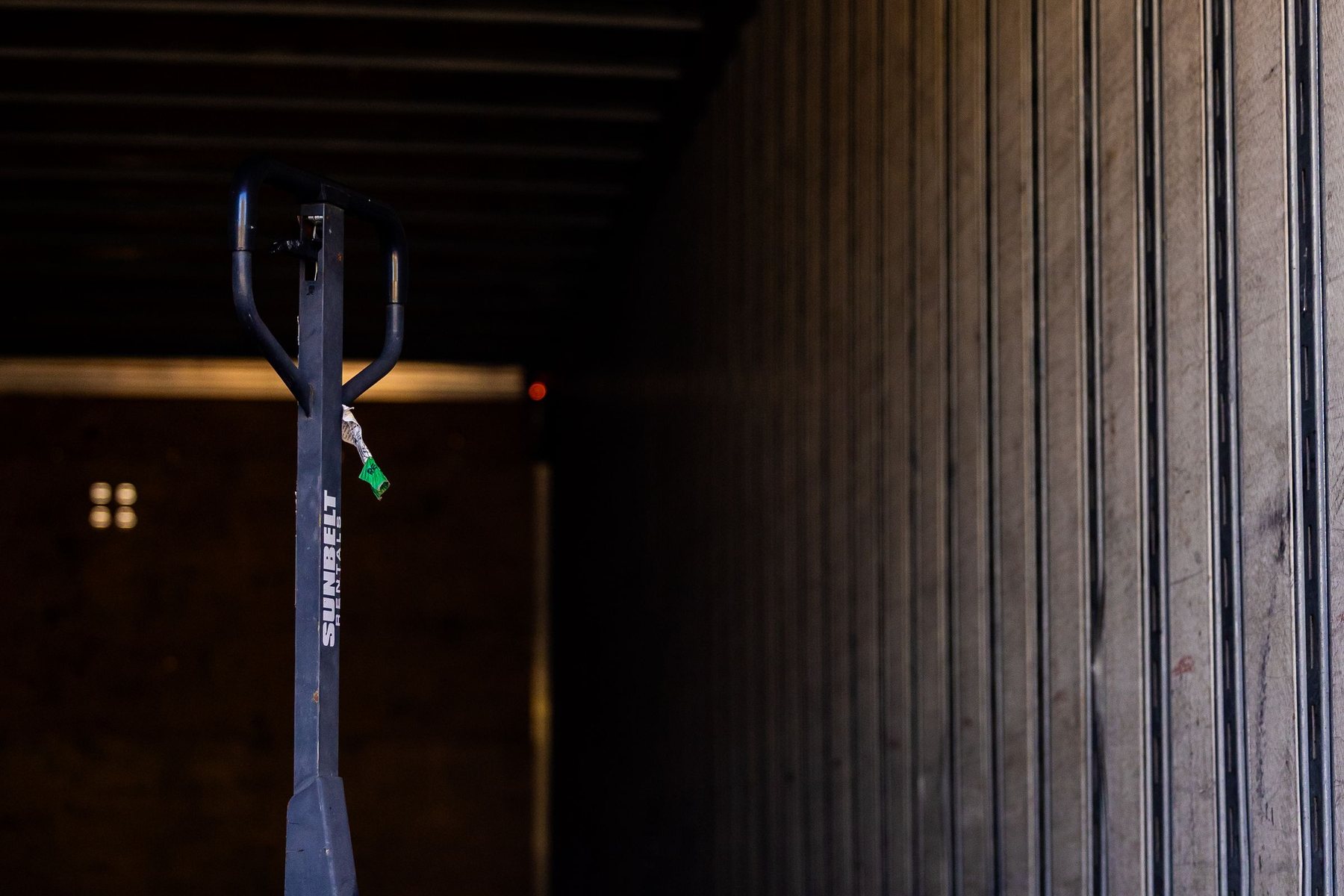
When insulated containers are laid out in a semi-trailer, how many fit is the small part of the question. Gross mass, axle distribution, centre of gravity, restraint, lid access, unloading order and the cold-air path all belong on the same plan.
Weight and centre of gravity
Road trucks and trailers carry defined axle loads to keep steering and braking, so they are particularly sensitive to the position of the cargo's centre of gravity. CTU Code, Annex 7, 3.1.7 states that the maximum cargo mass can be used only while the centre of gravity stays within a narrow band around the middle of the loading space, and it refers to vehicle-specific load distribution diagrams. Compare the mass and centre of gravity on your drawing with the limits in the vehicle's own documents; this 2014 guidance does not replace Turkish law. After a partial unload the combined mass and its distribution have changed even if the remaining containers stayed put, so the centre of gravity and restraint are rechecked at every stop.
Door and stop sequence
The first container or group to be delivered is planned near the door; that choice must not upset axle load, centre of gravity, restraint or airflow. Write the lid opening direction, the forklift or pallet-truck path and the ramp and rear tail-lift conditions into the plan. The loading-sequence article covers the multi-stop flow separately.
| Stage | Plan and record | Recheck |
|---|---|---|
| Start | Container ID, mass, position, axle, restraint | Door, airflow, equipment access |
| Loading | Sequence, centre of gravity, height | Gross and axle distribution after the last container |
| Partial unload | Container removed, remaining mass, open space | New centre of gravity and restraint |
| Final delivery | Remaining load, lids, return route | Safe collection of empties |
| Empty return | Empty IDs, stacking state | Movement, doors, equipment |
Fitting wheels or brakes under containers does not secure the load; the device that stops them moving is assessed together with the trailer connection and the cargo-restraint system. If a rear tail-lift is used, read the permitted load and load centre of the platform from the vehicle's operating manual.
In an actively refrigerated body, Thermo King asks for enough clearance for air to circulate around the load and for the evaporator inlets and outlets to stay unblocked; pre-cooling the load is a separate precondition in the same manual (Precedent manual, pp. 125-126). That information belongs to that model; it is not a fixed clearance for every trailer.
GEBHARDT Isotec TBX containers are not stacked on one another, so the vehicle plan is made on a single tier; the pallet-base models can be handled from all four sides by forklift and pallet truck. Filling large gaps with small containers is no solution if it upsets the centre of gravity or blocks airflow.
An example round: two containers come off at the first stop, one at the second, and empties come back. After every removal the remaining mass and distribution are worked out again; this is an example of the order of checks, not a capacity or legal limit. Complete the drawing with the refrigerated-trailer dimensions and stacking article and the actual vehicle documents.
If fresh and frozen cargo ride in one body, each product's conditions have to be held separately and airflow and route profile verified together; physical separation alone is not enough. Put the vehicle and trailer drawing, the load list, the axle and gross mass check, the restraint instruction and a check field after every partial unload into the acceptance file.

