
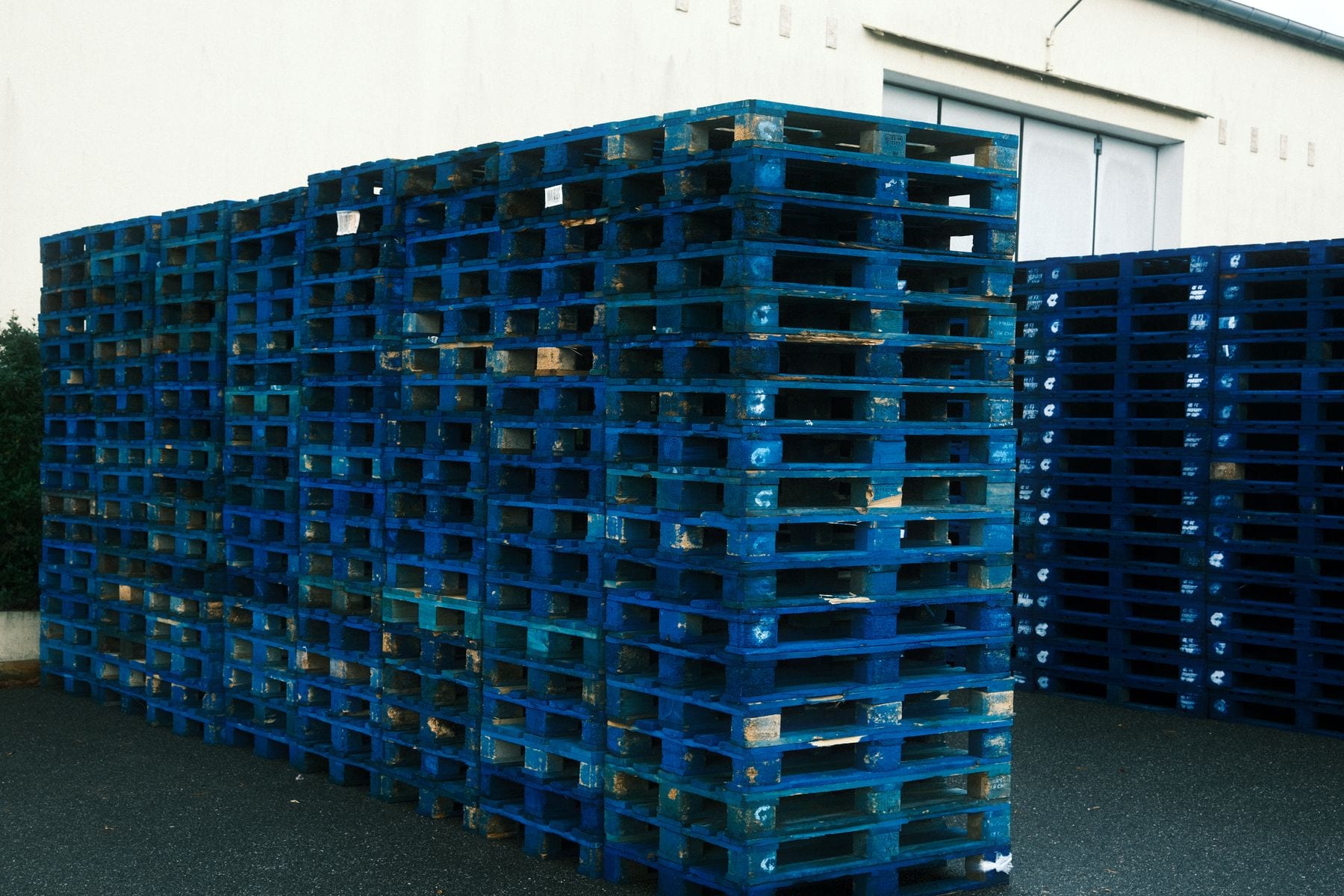
Two pallet sizes are common in Europe, and when container, crate and box dimensions follow that module no space is left on the pallet. EPAL's technical sheets give the two pallets as follows.
| Pallet | Footprint (mm) | Height | Empty weight | Safe working load |
|---|---|---|---|---|
| EPAL 1 (Euro pallet) | 800 × 1200 | 144 mm | approx. 25 kg | 1500 kg |
| EPAL 2 | 1200 × 1000 | 162 mm | approx. 35 kg | 1250 kg |
In a container, internal width decides how these footprints can sit. In Hapag-Lloyd's 20 ft dry example the inside is 5900 × 2352 × 2395 mm and the door opening 2340 × 2292 mm. Two 1200 mm sides (2400) or three 800 mm sides (2400) across the width come up 48 mm short, so in the same row one pallet goes 1200 across and its neighbour 800 across (2000 mm), leaving 352 mm. For EPAL 2, two 1000 mm sides or a 1200 plus a 1000 fit side by side (2200 mm). The carrier states that these dimensions vary by manufacturer and actual equipment, so the exact pallet count is calculated from the drawing of the container being loaded; see the container pallet capacity table and the pallet placement calculation for orientation trials.
For height the limit is the door, not the ceiling: in the same example internal height is 2395 mm while the door opening is 2292 mm, a 103 mm difference. After the Euro pallet's 144 mm, at most 2148 mm remains for product and protection in a single layer, and the allowance left for handling equipment and, in a cold load, for air circulation at the top brings it lower still. If two pallets are stacked, EPAL gives 5500 kg as the limit for the bottom EPAL 1 pallet under a laden stack.
In crate modules, four 600 × 400 mm crates fit a single 1200 × 800 mm layer exactly in geometric terms. That is a flat-layer calculation only; stacking height, crate walls, product overhang and air circulation are checked separately. A unit that does not fit the module exactly can still be the right choice: product sensitivity, loading direction and the gap needed for restraint can outweigh a few centimetres of geometric efficiency.
Being close to a standard size does not make a pallet acceptable to an exchange pool; beyond footprint, marking, construction and condition are also required. Before purchase, recording the door passage, floor contact and remaining clearance with the actual pallet and loaded crate, in a measured sketch or photographs, ties every dimension in the capacity calculation to the clear internal size.

